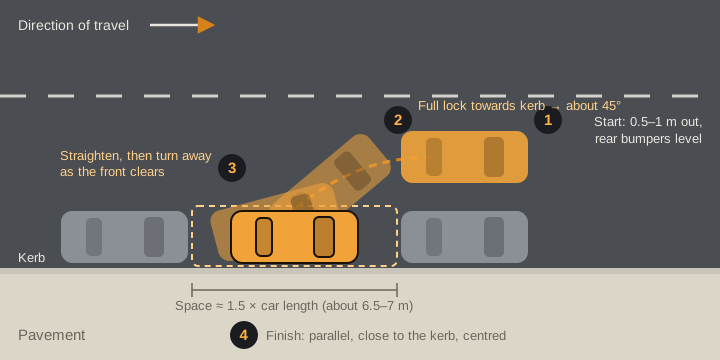
To parallel park, stop alongside the car in front of the space, about 0.5–1 m away with your rear bumpers level. Reverse slowly until your rear wheels are level with its rear bumper, then turn the wheel fully towards the kerb. At about 45°, straighten the wheels and keep reversing. When your front bumper clears the other car, turn fully away from the kerb until you are parallel, then centre the car in the space.
Key takeaways
- Choose a space at least about 1.5 times your car's length.
- Go slowly. Parallel parking is about control, not speed.
- Three moments matter: the start position, the turn-in point and the turn-back point.
- Finish parallel and close to the kerb without touching it.
- Check your mirrors and blind spots before and during the manoeuvre.
What is parallel parking?
Parallel parking means parking in line with the kerb, in a gap between two parked cars, usually by reversing into it. It is one of the most common manoeuvres on driving tests. In countries that drive on the right, such as Sweden, Germany and the USA, you normally park against the kerb on your right. In countries that drive on the left, such as the UK and Australia, everything in this guide is mirrored.
How much space do you need to parallel park?
A common rule of thumb is a gap of at least 1.5 times your car's length. For a typical 4.3 m hatchback, that is about 6.5 m. With practice you can fit into slightly shorter spaces, but a longer gap makes learning much easier. If a space looks too tight, it is fine to drive on and find another one. That is good judgement, not a failure.
How to parallel park in 6 steps
These steps assume the kerb is on your right. The diagram shows the four key positions.
-
Signal, check and position the car
Check your mirrors and signal towards the kerb. Stop alongside the car in front of the space, about 0.5–1 m away from it, with your rear bumper level with its rear bumper.
Tip: Too close and you may clip it when you turn. Too far away and you will end up far from the kerb.
-
Reverse slowly in a straight line
Check all around, including your blind spot, then reverse slowly with the wheels straight until your rear wheels are roughly level with the other car's rear bumper.
-
Turn fully towards the kerb
Turn the steering wheel fully towards the kerb (full lock) and keep reversing slowly. The rear of your car swings into the space.
-
Straighten at about 45°
When the car is at roughly 45° to the kerb, straighten the wheels and continue reversing in a straight line towards the kerb.
Tip: A common check is when you can see the whole front of the car behind you in your kerb-side mirror, or when the kerb appears in the lower corner of that mirror.
-
Turn fully away from the kerb
As soon as your front bumper has cleared the rear of the car in front, turn the wheel fully away from the kerb. The front of your car swings in and the car becomes parallel.
-
Straighten and centre the car
Straighten the wheels once you are parallel, then move slightly forwards or backwards so there is room in front and behind. Leave enough space for both cars to get out.
Common parallel parking mistakes (and how to fix them)
- Turning in too earlyThe rear goes in too steeply and hits the kerb. Wait until your rear wheels are level with the other car's rear bumper.
- Turning in too lateYou end up far from the kerb. Start turning a little earlier on your next attempt.
- Turning back too earlyThe front corner of your car can swing into the car in front. Make sure your front bumper has cleared it first.
- Reversing too fastYou have less time to judge the reference points. Use a very slow speed and control it with the brake.
- Forgetting to look aroundCyclists and pedestrians can appear at any time. Check your mirrors and blind spots before and during the manoeuvre.
What do examiners look for on the driving test?
Exact rules differ by country, but examiners generally assess three things:
- Control: a slow, steady speed and smooth steering.
- Observation: regular checks of mirrors and blind spots, and giving way to other road users.
- Accuracy: finishing reasonably close to and parallel with the kerb, inside the space, without hitting the kerb or another car.
A small correction is usually acceptable. Several back-and-forth moves, mounting the kerb or touching another car are much more likely to be marked as faults. For the official requirements, check your national authority, such as Trafikverket in Sweden or the DVSA driving test guidance in the UK.
How to practise parallel parking
Learn the reference points first, then repeat the manoeuvre until it feels automatic:
- Practise the steps in a simulator until you know when to turn in and when to turn back.
- Try spaces of different lengths. Start with long ones and gradually use shorter ones.
- Practise in a real car with a qualified instructor or supervisor, starting on a quiet street.
In Parking Simulator every attempt gets an examiner-style report: whether you are inside the space, your distance to the kerb, your angle, the number of forward and reverse moves, and a score out of 100. Each new attempt changes the parked cars, so you cannot just memorise one layout.
Frequently asked questions
How far from the kerb should you be when parallel parking?
There is no single international number. Examiners want the car close to and parallel with the kerb without touching it. Many instructors teach aiming for about 30 cm (one foot). Check your national driving-test authority for the exact expectation where you live.
Are you allowed to correct your position when parallel parking?
Usually yes. A small forward or backward adjustment is normal, as long as you stay in control and keep checking around you. Many back-and-forth moves, hitting the kerb or touching another car are far more likely to be marked as faults.
Is it easier to parallel park forwards or in reverse?
In reverse. When reversing, the steered front wheels swing the front of the car in behind the rear, so you can fit into a space only about 1.5 times the car's length. Driving in forwards needs a much longer gap.
Which way do I turn the steering wheel when parallel parking on the right?
With the kerb on your right, turn the wheel to the right (towards the kerb) to swing the rear in, straighten, then turn to the left (away from the kerb) to bring the front in. With the kerb on your left, do the mirror image.
Can I practise parallel parking online?
Yes. Parking Simulator is a free browser-based simulator where you can practise parallel parking between parked cars and get an examiner-style report with your distance to the kerb, angle, number of moves and a score.